Types of Candidate Sourcing: Why Job Postings and Proactive Sourcing Work Better Together
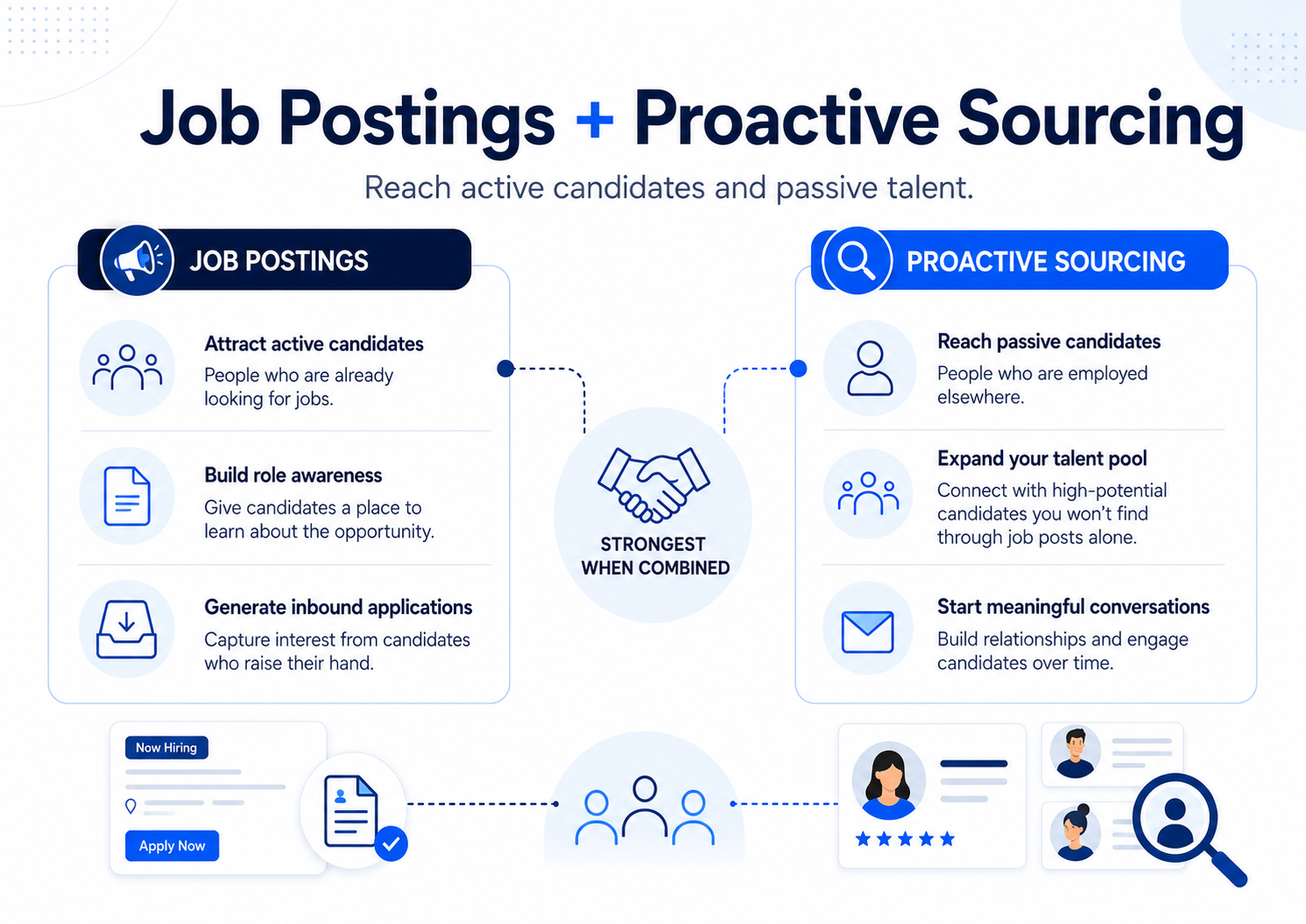
Types of Candidate Sourcing: Why Job Postings and Proactive Sourcing Work Better Together
Finding qualified candidates is one of the biggest challenges in hiring today.
Some employers are getting plenty of applicants, but not enough of the right applicants. Others are struggling to get candidates into the pipeline at all.
In both cases, the issue is often not just the job description, job board, or budget. It is the sourcing strategy.
Job postings are still an important part of hiring. They help you attract active job seekers, explain the opportunity, and give candidates a place to apply.
But job postings usually reach people who are already looking.
That leaves out another important group of potential candidates: people who are already employed, not actively applying, but open to the right opportunity if it gets in front of them.
That is where proactive sourcing can help.
A strong hiring strategy does not rely on one channel. It combines inbound applicants from job postings with proactive outreach to candidates who may not have found the opportunity on their own.
For employers looking to add proactive sourcing to their current hiring process, HireScore Find Talent helps teams search for and invite potential candidates by job title and location.
What Is Candidate Sourcing?
Candidate sourcing is the process of finding, attracting, and engaging potential candidates for an open role.
It can include several different methods, such as:
- Posting jobs online.
- Searching candidate databases.
- Asking for employee referrals.
- Reaching out to passive candidates.
- Promoting roles on social media.
- Building long-term talent pools.
The goal of sourcing is not just to get more applicants.
The real goal is to reach the right people and bring qualified candidates into your hiring process.
The Main Types of Candidate Sourcing
There are several ways companies can source candidates. Each method can play a different role depending on the position, labor market, industry, and hiring timeline.
1. Job Postings
Job postings are one of the most common sourcing methods.
This includes posting open roles on job boards, your careers page, industry sites, and other online platforms.
Job postings work well because they give active job seekers a clear place to learn about the role and apply.
What job postings do well
Job postings help employers:
- Attract people who are already looking for jobs.
- Share key details about the role, pay, benefits, schedule, and requirements.
- Create a central application path for candidates.
- Support the overall hiring process.
- Build visibility for open positions.
Job postings are especially useful for roles where there is a strong pool of active job seekers.
But for harder-to-fill roles, specialized positions, competitive markets, or jobs where the best candidates are already employed, job postings may not be enough on their own.
That does not mean job postings are ineffective.
It means they often work better when paired with other sourcing methods, like proactive candidate outreach through HireScore Find Talent.
2. Proactive Sourcing
Proactive sourcing is the process of searching for potential candidates and reaching out to them directly instead of only waiting for them to apply.
This is especially helpful for reaching passive candidates.
Passive candidates are people who are not actively applying for jobs, but may be open to a better opportunity if the right one is presented to them.
These candidates may already be employed, experienced, and successful in similar roles. In many cases, they can be some of the strongest candidates to connect with because they already have the skills, stability, and background you are looking for.
What proactive sourcing adds
Proactive sourcing helps employers:
- Reach people who are not actively applying.
- Target candidates by job title and location.
- Build another pipeline beyond inbound applicants.
- Connect with potential candidates earlier.
- Improve the quality and consistency of candidate flow.
- Reduce overreliance on job boards.
Proactive sourcing does not replace job postings. It strengthens them.
Job postings help you attract active candidates. Proactive sourcing helps you reach passive candidates.
Together, they give you a more complete sourcing strategy.
If your team wants to reach more passive candidates without replacing your existing job posting strategy, Find Talent can help you add proactive sourcing to your hiring process.
3. Employee Referrals
Employee referrals happen when current employees recommend people in their network for open roles.
This can be a strong sourcing method because employees often understand the company culture, job expectations, and type of person who may be a good fit.
Benefits of employee referrals
Employee referrals can help employers:
- Reach candidates who may not be actively applying.
- Build trust earlier in the process.
- Tap into employee networks.
- Find candidates who already have some connection to the company.
However, referrals can also be limited by the size and reach of your team’s network.
That is why referrals can be useful, but they should not be the only sourcing channel.
4. Social Media Recruiting
Social media recruiting involves promoting job opportunities and employer brand content on platforms like LinkedIn, Facebook, Instagram, X, and other channels.
This can help companies reach both active and passive candidates.
Social media is especially useful for:
- Building awareness.
- Sharing company culture.
- Promoting open roles.
- Highlighting employee stories.
- Staying visible with potential candidates over time.
Social media recruiting works best when it is connected to a clear next step, such as applying to a role, joining a talent pool, or learning more about the opportunity.
5. Talent Pools
A talent pool is a group of potential candidates your company can continue engaging over time.
This may include:
- Past applicants.
- Previous interviewees.
- Sourced candidates.
- Employee referrals.
- People who expressed interest in future roles.
- Candidates who were strong but not selected for a previous opening.
Talent pools are valuable because not every strong candidate is ready at the exact moment you have an opening.
Staying connected gives you a better chance of reaching them when the timing is right.
6. Recruiting Agencies or External Recruiters
Some companies use outside recruiters or agencies to help find candidates.
This can be helpful for specialized roles, executive searches, or positions that require more hands-on sourcing.
However, agencies can also be expensive, and the quality of the process may depend heavily on the recruiter’s network, outreach strategy, and understanding of the role.
For many employers, external recruiters are one piece of the sourcing mix, not the entire strategy.
Active Candidates vs. Passive Candidates
One of the most important parts of sourcing is understanding the difference between active and passive candidates.
These two groups behave differently, and they often require different sourcing strategies.
What are active candidates?
Active candidates are people who are currently looking for a job.
They may be:
- Browsing job boards.
- Applying to open roles.
- Updating their resume.
- Responding to job ads.
- Researching companies that are hiring.
Job postings are designed primarily to reach active candidates.
These candidates are already in the market, which makes them easier to attract through traditional job advertising.
What are passive candidates?
Passive candidates are people who are not actively looking for a new job, but may be open to the right opportunity.
They may already be employed. They may not be checking job boards. They may not know your company is hiring.
But if the role, location, compensation, schedule, culture, or growth opportunity is a strong fit, they may be interested in learning more.
This is why proactive sourcing can be so valuable.
It helps you get in front of candidates who may never see your job posting.
For companies trying to reach these candidates, HireScore Find Talent gives employers a direct way to search for and invite potential candidates.
Why Job Postings Alone May Not Be Enough
Job postings are important, but they depend on one key thing:
The right person has to see the post and decide to apply.
That does not always happen.
The best candidate for your open role might already have a job. They might not be searching. They might not be on the job board you are using. They might not even know your opportunity exists.
This is especially common for:
- Specialized roles.
- Skilled trades.
- Technical positions.
- Management roles.
- Healthcare roles.
- Manufacturing roles.
- Hard-to-fill local positions.
- Roles in competitive labor markets.
- Positions where qualified candidates are already employed.
When you only rely on job postings, you are mainly reaching candidates who are already in the market.
That can limit your candidate pool and make hiring feel reactive.
Proactive sourcing makes your strategy more active.
Instead of only waiting for people to come to you, you can search for potential candidates and invite them into the process.
If your applicant flow has slowed down or you are not seeing the right candidates, HireScore Find Talent can help you build another candidate pipeline beyond inbound applicants.
Why Proactive Sourcing Strengthens Your Hiring Strategy
Proactive sourcing does not replace job postings.
It adds another layer to your hiring strategy.
Think of job postings and proactive sourcing as two parts of the same system.
Job postings help you capture active demand.
Proactive sourcing helps you create new candidate interest.
Together, they give you a stronger and more complete sourcing strategy.
Proactive sourcing helps you reach candidates earlier
Instead of waiting until someone decides to apply, you can start a conversation with potential candidates before they enter the job market.
This can be especially helpful when hiring for roles where timing matters.
Proactive sourcing helps improve candidate quality
When you can search based on job title and location, you can focus your outreach on people who may be more likely to match the role.
This does not guarantee every candidate will be a fit, but it can help improve the quality of the people entering your pipeline.
Proactive sourcing helps reduce overreliance on job boards
Job boards can be effective, but they are not always predictable.
Some roles receive strong applicant flow. Others struggle, even with increased budget.
Adding proactive sourcing gives you another way to build your candidate pool when inbound applications are slow or inconsistent.
Proactive sourcing helps you reach passive candidates
This is one of the biggest benefits.
Passive candidates may not be applying, but they may be open to hearing about the right role.
Proactive sourcing gives you a way to reach those people directly.
To make that process easier, HireScore Find Talent helps employers search by job title and location and invite potential candidates directly.
When Should You Use Proactive Sourcing?
Proactive sourcing can be useful for many roles, but it is especially helpful when your current applicant pool is not giving you enough of the right candidates.
You may want to add proactive sourcing when:
- You are not getting enough applicants.
- You are getting applicants, but not enough qualified ones.
- The role requires specific skills or experience.
- The position is hard to fill in your local market.
- You want to reach people who are already employed.
- Job board performance has been inconsistent.
- You want to build a stronger long-term candidate pipeline.
- You are hiring in a competitive labor market.
If your hiring strategy is only built around waiting for applicants, proactive sourcing can give you a more targeted way to find potential candidates.
This is where Find Talent can be a helpful addition to your sourcing strategy.
What Is HireScore Find Talent?
HireScore Find Talent is a proactive sourcing tool that helps employers find and invite potential candidates by job title and location.
Instead of only relying on job postings to attract active applicants, Find Talent helps you reach passive candidates who may be employed elsewhere, not actively applying, but open to the right opportunity.
With Find Talent, employers can:
- Search for potential candidates.
- Customize outreach.
- Invite candidates directly to apply.
- Build another pipeline beyond job postings.
- Reach talent that may not be actively applying.
This gives companies another way to build their candidate pipeline beyond inbound job board applicants.
How HireScore Find Talent Supports Your Sourcing Strategy
HireScore Find Talent is designed to complement your current hiring efforts.
It does not replace your job postings. It strengthens them by giving you another way to reach candidates who may never apply on their own.
Find Talent can help you:
- Search for potential candidates by job title and location.
- Reach passive candidates who are not actively applying.
- Invite candidates directly to your opportunity.
- Build another sourcing channel beyond job postings.
- Improve candidate flow for hard-to-fill roles.
- Create a more proactive hiring strategy.
The best part is that it gives employers a way to be more targeted without abandoning the job posting strategy they already have in place.
You can learn more about how it works here: HireScore Find Talent.
Job Postings and Proactive Sourcing Work Better Together
The strongest sourcing strategies usually include multiple channels.
Job postings help you attract candidates who are already looking.
Proactive sourcing helps you reach candidates who may not be looking, but could be open to the right opportunity.
Referrals, social media, talent pools, and other sourcing methods can also support the process.
The key is not choosing one method and ignoring the rest.
The key is building a strategy that gives you more than one way to find qualified people.
If you want to add proactive sourcing to your hiring strategy, HireScore Find Talent is built to help you reach candidates beyond traditional inbound applicants.
Frequently Asked Questions About Candidate Sourcing
What is candidate sourcing?
Candidate sourcing is the process of finding and attracting potential candidates for an open role. This can include job postings, proactive outreach, employee referrals, social media recruiting, talent pools, and other methods.
What is proactive sourcing?
Proactive sourcing is when employers search for potential candidates and reach out to them directly instead of only waiting for applicants to apply.
Tools like HireScore Find Talent help employers add proactive sourcing to their hiring strategy.
What is the difference between active and passive candidates?
Active candidates are currently looking for jobs and applying to open roles.
Passive candidates are not actively looking, but may be open to the right opportunity if it is presented to them.
Are job postings still important?
Yes. Job postings are still an important part of hiring.
They help attract active candidates, share information about the role, and give candidates a place to apply.
However, job postings may work better when paired with proactive sourcing.
Why should companies use proactive sourcing?
Companies should use proactive sourcing because it helps them reach candidates who may not be actively applying.
This can improve candidate quality, expand the talent pool, and create another pipeline beyond inbound applicants.
Does proactive sourcing replace job postings?
No. Proactive sourcing works best as an addition to job postings.
Job postings help attract active candidates, while proactive sourcing helps reach passive candidates.
Build a Stronger Candidate Pipeline With HireScore Find Talent
If your team is only relying on job postings, you may be missing candidates who are not actively looking but could still be a strong fit.
HireScore Find Talent helps you add proactive sourcing to your hiring strategy, reach passive candidates, and build another pipeline beyond inbound applicants.
Learn more about HireScore Find Talent here:
https://hirescore.com/find-talent


